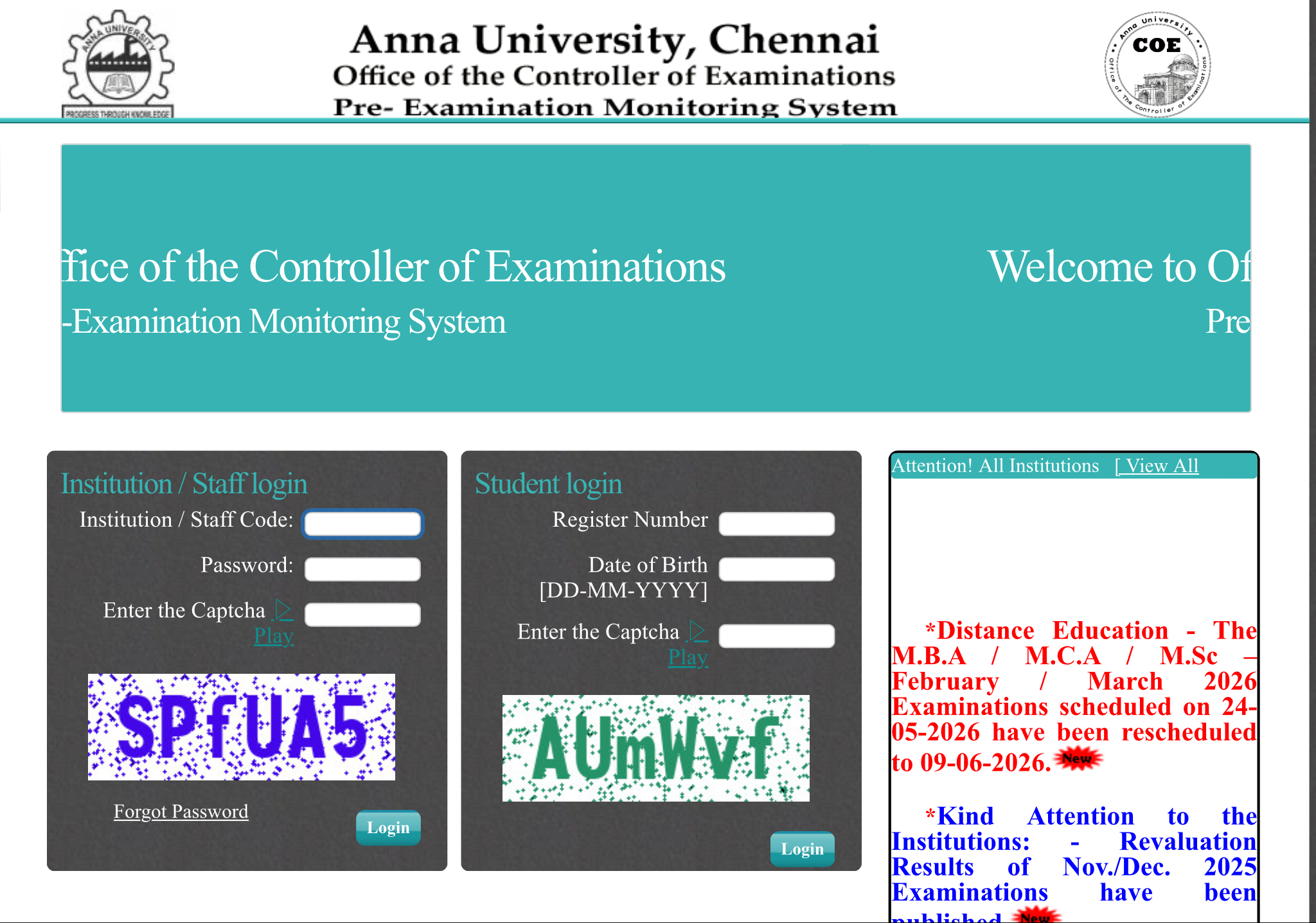
Distance Education – The M.B.A / M.C.A / M.Sc – February / March 2026 Examinations scheduled on 24-05-2026 have been rescheduled to 09-06-2026. Anna University Distance Education Exams Rescheduled: Key Update for MBA, MCA, and M.Sc Students
Students enrolled in the Distance Education programmes of Anna University have received an important update regarding the upcoming semester examinations. The university has officially announced that the M.B.A, M.C.A, and M.Sc examinations originally scheduled for 24 May 2026 have been postponed and rescheduled to 09 June 2026.
The announcement applies specifically to the February/March 2026 examination session conducted under the university’s distance education stream. The revision in the timetable is expected to benefit students by providing additional preparation time before the examinations begin
Important Note To Request Other Subject Important Questions Students are asked to Follow Our Instagram Page and Send the subject Details in our DM . With Subject Code , Sub Name with Department name. Subject which get more request will be publish soon – Click Here
MB25C09 Human Resource Management Notes, Important Questions, Question Bank, MCQ, Question Paper, Syllabus study materials
Strategic Perspectives in Human Resource Management Evolution of human resource management – The importance of the human capital – Role of human resource manager –Challenges for human resource managers – trends in Human resource policies – Computer applications in human resource management – Human resource accounting and audit – Introduction to HR analytics.
Workforce Planning and Talent Acquisition MB25C09 Human Resource Management MCQ Importance of Human Resource Planning – Forecasting human resource requirement – matching supply and demand – Internal and External sources – Organizational Attraction – Recruitment, Selection, Induction and Socialization – Theories, Methods and Process – Legal and ethical issues in hiring.
Training, Development and Knowledge Management MB25C09 Human Resource Management Notes Types of training methods –purpose- benefits- resistance. Executive development programme – Common practices – Benefits – Self development – Knowledge management systems and practices.
Motivation, Compensation, and Career Engagement Compensation plan – Reward – Motivation – Application of theories of motivation – Career management – Mentoring – Development of mentor – Protégé relationships- Job Satisfaction, Employee Engagement, Organizational Citizenship Behavior: Theories, Models.
Performance Management and Employee Movement MB25C09 Human Resource Management Important Questions Method of performance evaluation – Feedback – Industry practices. Promotion – Demotion, Transfer and Separation – Implication of job change. The control process – Importance – Methods – Requirement of effective control systems grievances – Causes Implications – Redressal methods.
HR Governance and Emerging Issues HR control processes – Legal compliance in HRM – Diversity and Inclusion – Ethical HR practices – Employee wellbeing – Future of work: AI in HRM, remote workforce management – HR metrics and dashboards – Global HRM trends – Sustainable HRM practices.
References: 1. Gary Dessler & Biju Varkkey, Human Resource Management, 16th Ed., Pearson Education, 2024.
2. David A. DeCenzo, Stephen P. Robbins, Susan L. Verhulst, Fundamentals of Human Resource Management, Wiley, 13th Ed., 2024 3. Uday Kumar Haldar, Juthika Sarkar, Human Resource Management, Oxford University Press, 2nd Ed., 2023. 4. Wayne F. Cascio, Managing Human Resources: Productivity, Quality of Work Life, Profits, McGraw Hill, 12th Ed., 2024. 5. Michael Armstrong, Armstrong’s Handbook of Strategic Human Resource Management, Kogan Page, 8th Ed., 2023. 6. Luis R. Gomez-Mejia et al., Managing Human Resources, Pearson, 8th Ed., 2023. 7. Dipak Kumar Bhattacharyya, HR Analytics: Understanding Theories and Applications, Sage Publications, 2nd Ed., 2022. 8. Ivancevich, Human Resource Management, McGraw Hill, 14th Ed., 2023. 9. Bernardin, Human Resource Management, Tata McGraw Hill, 11th Ed., 2022.
MB25C08 Business Research Methods Notes, Important Questions, Question Bank, MCQ, Question Paper, Syllabus study materials
Foundations of Business Research and Scientific Inquiry Business Research – Definition and Significance – the research process – Types of Research – Exploratory and causal Research – Theoretical and empirical Research – Cross –Sectional and time – series Research – Research questions / Problems – Research objectives – Research hypotheses – characteristics – Research in an evolutionary perspective – the role of theory in research.
Research Design and Measurement Techniques Research design – Definition – types of research design – exploratory and causal research design – Descriptive and experimental design – different types of experimental design – Validity of findings – internal and external validity – Variables in Research – Measurement and scaling – Different scales – Construction of instrument – Validity and Reliability of instrument.
Data Collection Methods and Sampling Techniques MB25C08 Business Research Methods MCQ Types of data – Primary Vs Secondary data – Methods of primary data collection – Survey Vs Observation – Experiments – Construction of questionnaire and instrument – Types of Validity – Sampling plan – Sample size – determinants optimal sample size – sampling techniques – Sampling methods.
Data Preparation and Analytical Techniques Data Preparation – editing – Coding –Data entry – Validity of data – Qualitative Vs Quantitative data analyses – Applications of Bivariate and Multivariate statistical techniques, Factor analysis, Discriminant analysis, Cluster analysis, Multiple regression and Correlation, Multidimensional scaling – Conjoint Analysis – Application of statistical software for data analysis.
Report Writing and Research Communication MB25C08 Business Research Methods Important Questions Research report –Types – Contents of report – need for executive summary – chapterization – contents of chapter – report writing – the role of audience – readability – comprehension – tone – final proof – report format – title of the report – ethics in research – Ethics in research – Subjectivity and Objectivity in research.
Integrity and Trends in Business Research MB25C08 Business Research Methods Notes Research Integrity – Emerging Trends: Digital Surveys, AI in Research, Online Panels, Real-Time Analytics – Case Studies on Ethical Dilemmas in Research.
References: 1. Donald R. Cooper, Pamela S. Schindler, J. K. Sharma, Business Research Methods, McGraw Hill, 13th Ed., 2021 2. Uma Sekaran & Roger Bougie, Research Methods for Business: A Skill Building Approach, Wiley, 7th Ed., 2020 3. William G. Zikmund et al., Business Research Methods – South Asian Perspective, Cengage, 9th Ed., 2018 4. Alan Bryman & Emma Bell, Business Research Methods, Oxford University Press, 5th Ed., 2019 5. R. Paneerselvam, Research Methodology, PHI Learning, 2nd Ed., 2015 6. Mark Saunders, Philip Lewis, Adrian Thornhill, Research Methods for Business Students, Pearson, 8th Ed., 2022 7. Davis Bunn & Jennie Tranter, Business Research and Statistics Using Excel, Wiley, 1st Ed., 2021
MB25C07 Applied Operations Research Notes, Important Questions, Question Bank, MCQ, Question Paper, Syllabus study materials
Introduction to Quantitative Decision Models Relevance of quantitative techniques in management decision making. Linear Programming formulation, solution by graphical and simplex methods (Primal – Penalty, Two Phase), Special cases. Sensitivity Analysis. (Theory and Problem)
Extensions of Linear Programming – Transportation & Assignment (Problems) Transportation Models (Minimising and Maximising Problems) – Balanced and unbalanced Problems – Initial Basic feasible solution by N-W Corner Rule, Least cost and Vogel’s approximation methods. Check for optimality. Solution by MODI / Stepping Stone method. Case of Degeneracy. Transhipment Models. Assignment Models (Minimising and Maximising Problems) – Balanced and Unbalanced Problems. Solution by Hungarian and Branch and Bound Algorithms. Travelling Salesman problem. Crew Assignment Models.
Decision Theory and Game Theory Applications (Theory and Problem) MB25C07 Applied Operations Research MCQ Decision making under risk – Decision trees – Decision making under uncertainty. Game TheoryTwo-person Zero sum games-Saddle point, Dominance Rule, Convex Linear Combination (Averages), methods of matrices, graphical and LP solutions.
Inventory Control and Replacement Models (Theory and Problem) MB25C07 Applied Operations Research Notes Inventory Models – EOQ and EBQ Models (With and without shortages), Quantity Discount Models. Replacement Models-Individual replacement Models (With and without time value of money) – Group Replacement Models.
Queuing Models and Monte Carlo Simulation (Problem) Queuing Theory – single and multi-channel models – infinite number of customers and infinite callingsource. Monte Carlo simulation – use of random numbers, application of simulation techniques
Emerging Trends and Tools for Quantitative Decision-Making (Theory and Problem) Important Questions Integration of quantitative techniques in Business analytics – Use of Excel Solver, R, and Python in operations research – Introduction to prescriptive analytics.
References: 1. Hamdy A. Taha, Operations Research: An Introduction, 11th Ed., Pearson Education, 2022 2. G. Srinivasan, Operations Research: Principles and Applications, PHI Learning, 2nd Ed., 2011
3. N. D. Vohra, Quantitative Techniques in Management, Tata McGraw Hill,2010 4. R. Paneerselvam, Operations Research, PHI Learning, 4th Ed., 2018 5. Frederick Hillier & Mark Hillier, Introduction to Management Science, McGraw Hill India, 6th Ed., 2023 6. Bernard W. Taylor III, Introduction to Management Science, Pearson, 9th Ed., 2020 7. S. Kalavathy, Operations Research, Vikas Publishing House, 4th Ed., 2022 8. Nagraj B., Barry R. & Ralph M. S. Jr., Managerial Decision Modelling with Spreadsheets, Pearson Education, 2nd Ed., 2007
MB25C06 Entrepreneurship Development Notes, Important Questions, Question Bank, MCQ, Question Paper, Syllabus all study materials
Entrepreneurial Mindset and Competencies: Entrepreneurship concept – Entrepreneurship as a Career – Entrepreneurial Personality – Characteristics of Successful Entrepreneurs – Knowledge and Skills of an Entrepreneur.
Entrepreneurial Ecosystem and Policy Support: Entrepreneurial Environment – Role of Family, Society and Culture – Government Industrial Policies – State and Central Schemes (Startup India, Stand-Up India, PMEGP, MSME) – Role of DICs, SIDBI, EDII, TBI, DST, NSIC – Role of Industry Associations and Support Services – Incubation Centers and Accelerators – International Policy Ecosystem (Global Innovation Index, GEM).
MB25C06 Entrepreneurship Development Notes
Opportunity Identification and Business Planning: Sources of Product for Business – Prefeasibility Study – Criteria for Selection of Product – Ownership – Capital Budgeting- Project Profile Preparation – Matching Entrepreneur with the Project – Feasibility Report Preparation and Evaluation Criteria.
Launching the Startup and Funding Mechanisms: Finance and Human Resource Mobilisation – Operations Planning – Market and Channel Selection -Growth Strategies – Product Launching – Incubation, Venture capital, Start-ups.
Managing and Scaling the Business: Small Business Operations – Inventory, Finance, and People Management – Customer Acquisition and Retention – Digital Tools for Small business – Measuring Business Performance – Managing Uncertainty and Change – Business Model Innovation – Lean Startup Strategy – Scaling Frameworks – Case Studies on Growth-Oriented Startups.
MB25C06 Entrepreneurship Development MCQ
Business Sustainability, Exit Strategies, and Ethics: Monitoring and Evaluation of Business – Business Sickness – Prevention and Rehabilitation of Business Units – Effective Management of small Business – Case Studies.
References: MB25C06 Entrepreneurship Development 1. Khanka, S. S. (2020). Entrepreneurial development (Rev. ed.). S. Chand & Company Ltd. 2. Hisrich, R. D., Peters, M. P., & Shepherd, D. A. (2024). Entrepreneurship (12th ed.). McGraw Hill. 3. Roy, R. (2020). Entrepreneurship (3rd ed.). Oxford University Press. 4. Kumar, A. (2012). Entrepreneurship. Pearson Education. 5. Chandra, P. (2023). Projects – Planning, analysis, selection, implementation and review (10th ed.). Tata McGraw Hill. 6. Murthy, N., & Tata, R. Biographical and interview compilations.
The Office of the Controller of Examinations at Anna University, Chennai, has released an official notification regarding the payment of examination fees for the February/March 2026 Distance Education examinations. This announcement is specifically intended for students enrolled in non-functioning study centers under the Distance Education program.
According to the notification, the examinations are scheduled to be conducted in May/June 2026. Students must complete their registration through the official web portal within the specified timeline, which begins on April 30, 2026, and ends on May 6, 2026. It is mandatory for eligible students, including those from MBA, MCA, and MSc programs under the Distance Education stream, to register within this period.
The fee structure varies depending on the course. For MBA, MCA, and MSc programs, the fee is ₹450 per theory or practical subject. However, for project work, the fee is ₹600. Additionally, final semester students are required to pay ₹1,000 towards the issuance of essential documents such as the Consolidated Statement of Marks, Provisional Certificate, and Degree Certificate.
Students are required to follow a structured registration process. They must log in to the official Anna University COE web portal using their register number, open the registration preview, and verify their subject details. In case of discrepancies or the need to change the examination center, students must submit valid proof and request approval via email. It is important to note that examination center changes are not guaranteed and will only be considered after verification.
The payment of fees must be completed online. After successful payment, students should download and print the acknowledgement form for future reference. The last date for fee payment is May 6, 2026, and no registrations will be accepted after this deadline.
Important Note To Request Other Subject MCQ Students are asked to Follow Our Instagram Page and Send the subject Details in our DM . With Subject Code , Sub Name with Department name. Subject which get more request will be publish soon – Click Here
The announcement regarding the change of examination centres for the April/May 2026 examinations has brought important updates for students enrolled in closed, autonomous, deemed, and less strength colleges. These changes apply to both theory and practical examinations for certain institutions, while others will be affected only in theory exams. Understanding these updates is essential to avoid confusion and ensure a smooth examination experience.
The decision to shift examination centres is typically made to maintain fairness, improve logistical efficiency, and ensure proper allocation of resources. For closed, autonomous, and deemed colleges, both theory and practical exams will now be conducted at designated alternative centres. This move helps standardize evaluation conditions and ensures that all students are assessed under uniform supervision and infrastructure.
For less strength colleges—institutions with relatively low student enrollment—the change applies only to theory examinations. These colleges often face challenges such as limited invigilation staff or inadequate facilities to host large-scale exams. By reallocating students to centralized centres, authorities aim to provide a more controlled and equitable environment for conducting examinations.
Important Note To Request Other Subject MCQ Students are asked to Follow Our Instagram Page and Send the subject Details in our DM . With Subject Code , Sub Name with Department name. Subject which get more request will be publish soon – Click Here